
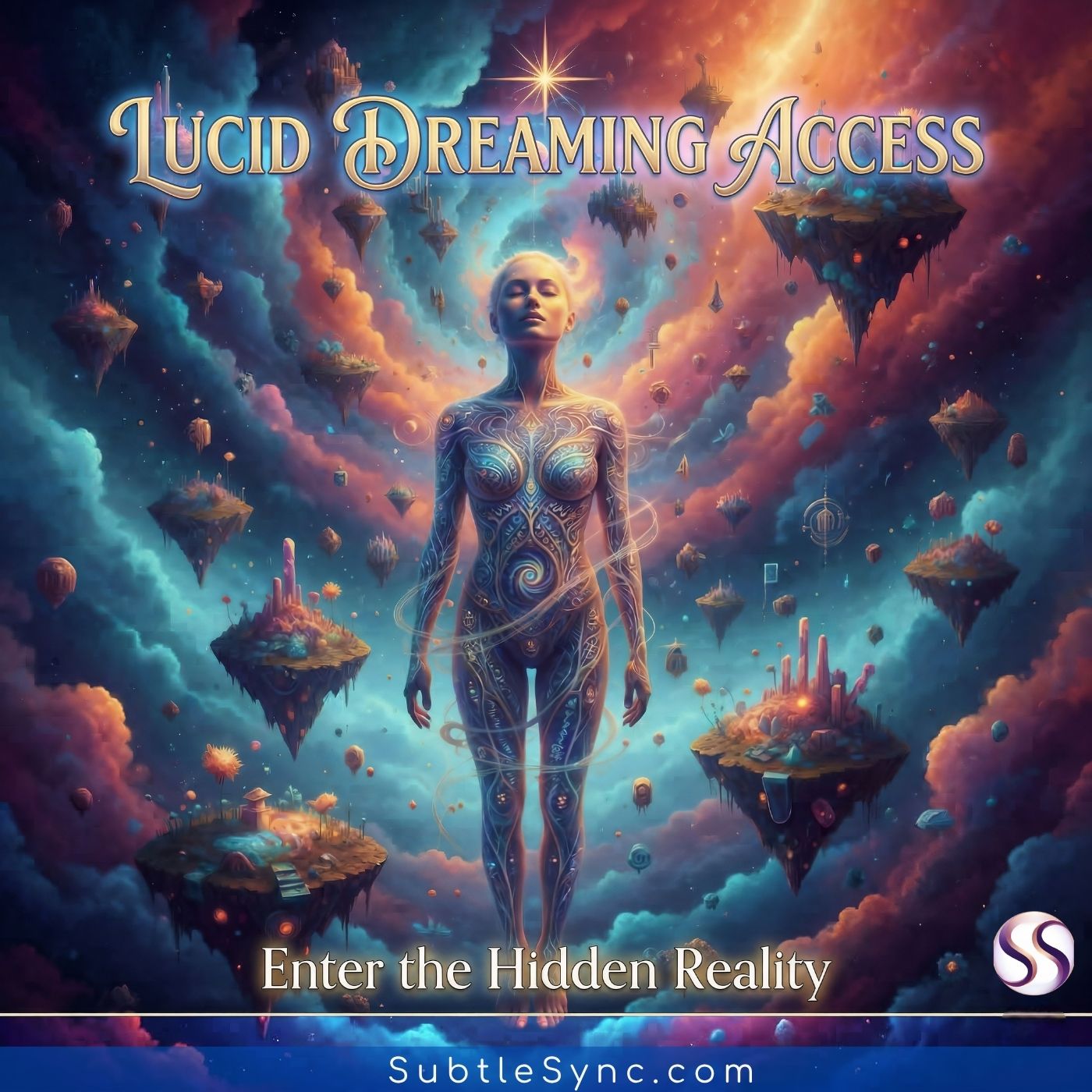
Description
The dream world is a vast frontier, teeming with objects, phenomena, and secrets that can be studied indefinitely. It offers a space for the most fascinating experiments, where every journey reveals something new. Most importantly, these experiences can be applied to enrich your waking life. But how can we speak of exploration and adventure when the average person struggles to even enter a Lucid Dream?
Over the last 5,000 years, humanity has gathered a colossal amount of knowledge about the physical world, yet we know almost nothing about the world of dreams. This is a profound misunderstanding of our reality. All it takes is a beginning… but the hurdle for most is a simple, frustrating inability to become self-aware while dreaming.
To limit yourself to the physical world alone—depriving yourself of several hours of active presence and activity every single night—is a staggering injustice. Most people don’t even realize they are missing out on half of their lives.
The Mechanics of the Dream World
Navigating the dream realm becomes easy once you have the correct subconscious attunement. The dream world is a real, existing collective space. However, its “content” is 90-95% the work of your own subconscious.
Every scene in a dream is a “sphere of perception,” and it is actually quite small. To prove this, once you become lucid, simply try walking straight ahead without turning. The system will immediately try to distract you or throw obstacles in your path. If you persist, you will soon hit a barrier—the boundary of the scenery, the shell of the illusion.
This is done to conserve your subconscious resources. Whether it’s a high-end video game or a dream sphere, the system optimizes graphics to minimize the load on the “processor” and RAM. Just like in a game where distant mountains only render in detail as you approach them, the dream world loads new locations and “unloads” the ones you’ve left behind.
High-Definition Reality
While you are unconscious, dream detail is often “low-res” and blurry. If another lucid dreamer were to enter your non-lucid dream, they might see you in “blocky pixels,” like an old-school gaming console. But the moment you become aware—or even just squint at an object while dreaming—the resolution spikes. You’ll see every wrinkle and fine hair on a character’s face. Your memory of the real world begins to detail the dream objects at a microscopic level.
The Matrix of 64
Here is the secret: the dream world consists of only 64 base scenes and 4,096 scenario variations ($64 \times 64$, echoing the 64 hexagrams of the I-Ching). You might not recognize these scenes at first because the “decorations” change constantly, but the foundation remains. The same building might be a hospital in one dream and a hotel in another, yet the descent into the basement will be identical.
It gets even more interesting: everything you have ever experienced in real life, every location you have ever visited, exists within the dream world as a single, unified space. This is a specific territory where the streets and places from your physical past miraculously merge into one map. Within this realm, a familiar hill in San Francisco might seamlessly transition into a narrow cobblestone lane in Prague where you once spent your vacation, or lead you straight onto a sun-drenched beach in Thailand where you once stayed for the winter. In the dream world, all your real-life travels are condensed into one continuous, traversable landscape.
- The Dreamer’s House: Usually located at the center of this map, it constantly transforms into the various houses or apartments you’ve lived in.
- Universal Landmarks: Certain areas are identical for everyone on Earth—the Labyrinth in the East, the Mountains in the North, the Wasteland in the West, or the Seer’s Hut.
- The Catch: You can only enter the sphere of the Seer while fully lucid; otherwise, the location will always slip away from you.
Why Recognition is the Key
The average person fails to notice that the landscape is always the same. If they did, they would instantly realize they were dreaming. That realization turns every night into hours of adventure and research. Every. Single. Night.
For us “oneironauts,” the dream world is as accessible as the physical one. Falling asleep is like walking from one room to another. We recognize the transition instantly and go about our “business.” For us, the room of physical reality and the room of the dream world are of equal value. We live actively in both. We are masters of both.
How This Audio Attunement Works
This program gradually recalibrates your subconscious, installing a “recognition patch” for the dream world. Over time, the dream realm will stop feeling exotic or out of reach. As your “dream memory” returns, the dream world becomes a full-fledged environment for you to inhabit (provided you continue basic practices like reality checks).
You will become an “Advanced User” in both worlds.
Eventually, this leads to an “explosion” of dream memory. Once you start recognizing the locations you’ve actually known for years, a cascade of previously blocked memories—thousands of past dreams—will rush into your conscious mind.
Master the basic skill of Dream Recognition first. Once you do, we will show you the path to even more incredible things that apply to both worlds.
Note: For this new subconscious “recognition patch” to take hold and trigger consistent lucidity, you must have a genuine interest in Lucid Dreaming. If you are just a casual passerby, this program is unlikely to work. Curiosity alone isn’t enough to “see behind the curtain.” You need a spark of passion—a true desire to experience these vivid sensations and unforgettable adventures. Only then will the program find its footing and teach you how to be present in the world of dreams.