

The cliché reason why many of your desires never manifest in your life is simply the wrong phrasing of those very desires. All your goals and wishes must be translated into a language your subconscious understands. You must avoid abstract phrasing and express your desires with ultimate clarity. Correct phrasing in the language of the subconscious includes a visually clear image and, possibly, even sounds, smells, and so on.
How do you do this? Find a five or six-year-old child and try to describe one of your desires to them.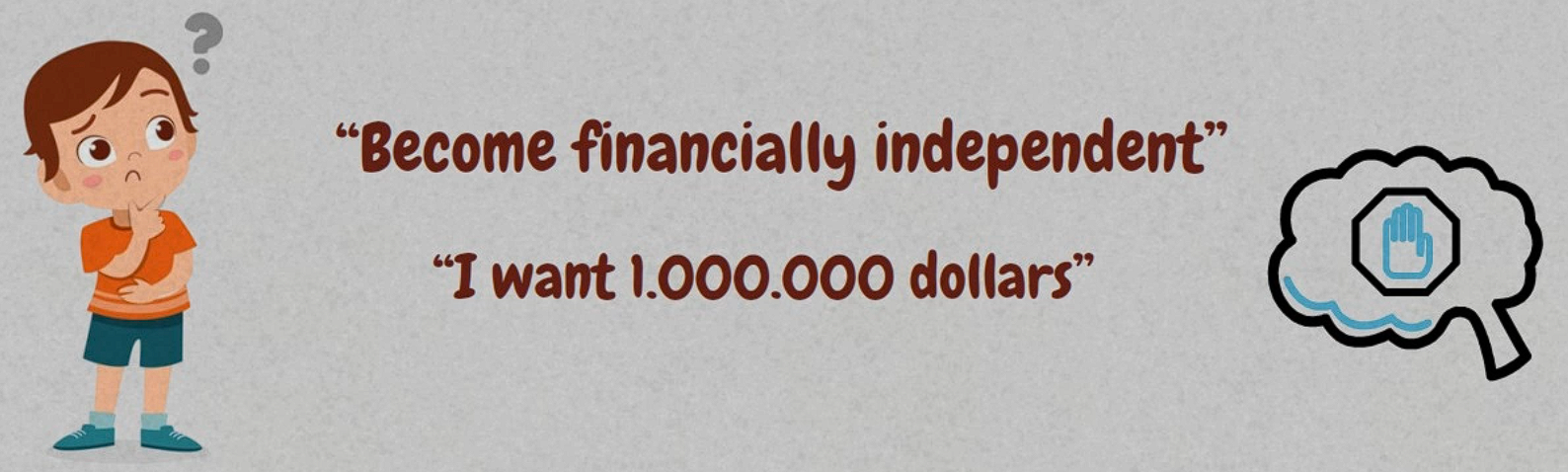
Most likely, this child won’t understand your wish to “become financially independent” at all. And even if you say, “I want a million dollars,” they won’t grasp what it means to actually have a million dollars. Your subconscious, which is very similar to a small child in its thinking and behavior, won’t perceive such a message either. Because your inner child simply isn’t interested in that goal. Why would they care about a pile of paper called “banknotes”? It won’t ignite the fire of interest or curiosity in them.
On the other hand, a child perfectly understands the image of walking barefoot on warm sand and enjoying the sound of ocean waves.
If goal-setting was done incorrectly or remains vague, the subconscious won’t give you the energy and motivation to achieve it. Only when your desire is formulated so clearly that even a child can understand it—only then will your subconscious begin working toward bringing you closer to that goal. And you can be sure: when your subconscious is on your side, it provides incredibly powerful support on your journey.
Furthermore, you need to relearn how to want things. The problem is that, unlike a child who always knows exactly what they want—and they want a lot—an adult has not only forgotten how to allow themselves to want whatever they desire but has inevitably begun replacing their true desires with imposed, external ones copied from others.
Often, these “foreign” desires promise external well-being but never internal peace. If you choose a goal that isn’t yours, your strength will soon run out, and you’ll lose motivation, ending up disappointed in the goal itself.
What should you do if you struggle to answer, “What do I want?” You can apply the principle of the opposite. To do this, first pay attention to what you DISLIKE at the moment. Look at what you would like to remove from your life or replace with something else.
For example: “I don’t like the apartment I live in.” From here, you understand: “I want a cozy apartment with a specific interior.”
But don’t just aim for the direct opposite of what you dislike. It might not be just one desire, but several. Perhaps you don’t even need a different apartment; maybe you’ve actually wanted a new orthopedic bed or a comfortable sofa for a long time but thought you couldn’t afford it for various reasons.
Use the “principle of the opposite” more often to start seeing what you dislike in your lifestyle and how you’d like to change it. The more you do this—replacing things or situations with what truly resonates with you—the more satisfaction you will find in life, and the more it will charge you toward new results.
 One of the surest ways to distinguish your true desires from imposed ones is to get a bodily response to the stated desire. A response from the body is confirmation that the current desire has resonated with your deep self, your “Inner Child”—call it what you will.
Try setting a goal for yourself: “I want to become a movie star.” Listen to yourself. Does anything inside you react to this goal? Most likely, no. Besides, wanting to be a “movie star” is an imprecise goal. Almost all movie stars achieved their fame as a consequence of following a different desire—the desire to skillfully play a role in a script or a play.
Even ten million dollars usually triggers no response in the body. Because money, in and of itself, means nothing. But diving among coral reefs off the coast of Sharm el-Sheikh, going to a music festival, launching your own clothing brand, or creating the wedding-planning business of your dreams might cause a pleasant warmth in the chest or goosebumps for someone. That physical reaction is your body signaling: “This desire is yours.”
True desires do not fade; they inspire you and provide the necessary push for action. Circumstances and people around you might tell you it’s a crazy idea or that you can’t handle it, but the nature of a genuine desire is that it tells everyone to “get lost” and paves a chain of events so that, eventually, you reach your goal and enjoy it.
The power of such a desire lies in the fact that the body forms the emotions; in response to those emotions, corresponding thoughts appear; and those thoughts, in turn, translate into concrete actions. This sequence always leads to the initially set goal.

Another mistake in formulating a desire is focusing only on external signs. You see a beautiful picture of a man driving an expensive car or a video of a girl showing off a luxury penthouse on the 40th floor. But when you get that car, many things about it don’t suit you, and in that “dream” apartment, for some reason, you don’t feel comfort or peace.
You buy the suit you’ve been eyeing for a long time, only to find it’s completely uncomfortable. You bring home a long-awaited food processor, but after the first use, you put it on a back shelf and forget about it forever. You start a relationship with a tall, blue-eyed handsome man, and he turns out to be a total psycho or completely unreliable.
When forming a goal, the most important thing is how you feel, how you experience it, and what sensations you feel inside.

Your internal state and the “experience” of your dream are vital. If it’s an apartment, then besides the external details, you must feel how pleasant it is every time you return there at the end of the work day. How it surrounds you with comfort and warmth. How it helps you relax and fully rest. How you brew yourself coffee and walk across the heated floor to your favorite chair by the window to enjoy the evening city view accompanied by music…
The physical sensations are very important here.
If it’s a car, feel how you enjoy its maneuverability and responsive handling while driving. Feel the functionality and comfort of the interior, as if this car was designed specifically for you.
If it’s a household appliance, imagine how you enjoy yourself every time you use the device.
If it’s your “other half,” feel and live through how secure, calm, and confident you feel next to this person. You feel their care, attention, and respect. And every new day, you get to know each other from a new side, which brings you even closer and makes your union stronger.

Sensations during goal-setting account for 90% of success.
The remaining 10% are the specific details. For example, if you plan to buy a car in the future, specify your goal as much as possible:
How much will the car cost?
What color and brand will it be?
What is the year of manufacture?
When do you plan to buy it?
Where will you get the necessary amount of money for the purchase? …and so on.
Every goal must have a quantitative, qualitative, and temporal dimension.
Maximum clarity in phrasing significantly accelerates the realization of any goal. You might not yet fully understand the necessity of all these details. But it is very important: in a sense, you are “placing an order” for what you want. All these details will protect you from any deviations from the plan in the future, and with a high probability, you will get exactly what you formulated, in a way that is convenient for you—without surprises or unexpected issues. Such is the power of the human subconscious. It’s like being in an electronics store: you tell the salesperson the details of what you want so they can offer you exactly what meets your needs.

By doing everything as described above, you can avoid misunderstandings when you finally meet your dream; you won’t be disappointed and will experience only positive emotions.

This really works. Once you try proper goal-setting on a few desires, you’ll get so used to it that the next time you need to buy, say, a new blender, you won’t run straight to the store. First, you’ll imagine the joy and “vibe” of how the new blender easily handles any load, makes you delicious smoothies and soups, and the pleasure of how quickly and easily it can be cleaned. And only then do you go to the store and choose the model that fully satisfies you.
Question: “What if I can’t imagine what it’s like to own the object of my dreams because I’ve never had such an experience in my life?”
Answer: Become the owner for at least one day. If it’s your dream house, rent a similar house for 24 hours; stay in it and feel what it’s like to live there. If it’s a car—same thing: rent it or take a test drive. Thanks to this technique, your subconscious will understand exactly what you want.

There is a technique called “The User,” which is similar in meaning. It is designed to gently expand your comfort zone. The principle is that nothing stops us from feeling like a “user”—and therefore, to some extent, an owner—even for a short time, of a thing that doesn’t belong to us yet. A long time ago, following this technique, I sat behind the wheel of a friend’s car that was five times more expensive than my old one. Admiring the interior, I imagined it was mine. I literally lived the role and soaked up the new sensations. This helped me remove unnecessary internal resistance and see my dream as a more than realistic and achievable goal. A few months later, I bought a car of a different brand but roughly the same value—five times more expensive than my previous one.
An Important Nuance Regarding Financial Goals
One of my clients once asked me: “I can’t save up for a big goal; I keep ‘draining’ the money. I save it, and then it’s gone. Either I spend it myself, or it disappears through events that happen to me.”
What happens when you try to save money for a massive goal all at once? You save, and save, and save, denying yourself even minor expenses. Because of this, tension grows inside you because you are using very little of the money while you have accumulated a lot. To release this tension, your subconscious leads you to “drain” that money. Something happens in your life that forces you to spend it.
How do you achieve financial goals effectively? Take the financial goal of the next level, rather than jumping eight steps at once.
If the maximum financial goal you’ve realized so far was a $50 bouquet of flowers for your mother, you shouldn’t set your next goal as an Audi Q8 or a $300,000 house.
You think: “I’ll save as much as possible, deny myself non-urgent needs, and then I’ll save up those three hundred thousand faster!”
But you must know that growth in financial goals follows a specific rule: take the goal of the next level and do not start with the biggest one. In other words, I suggest you “buy” intermediate goals.
You might say: “But that’s much more expensive! That requires spending so much more money.” But look at the paradox: following the second option is actually faster and easier.
It seems rational to earn for the biggest goal first, thinking that smaller purchases will be easier later. But I suggest you first set a goal for, say, $20,000—home renovation; then $50,000—buying a car; $100,000—college tuition for your son or daughter; $200,000—starting capital for your small business; and only then $300,000—for the house.
I am suggesting that you spend significantly more than $300,000 in total. This is both faster and easier than trying to accumulate $300,000 that you cannot “hold” and that feels unbearable to you at this stage.
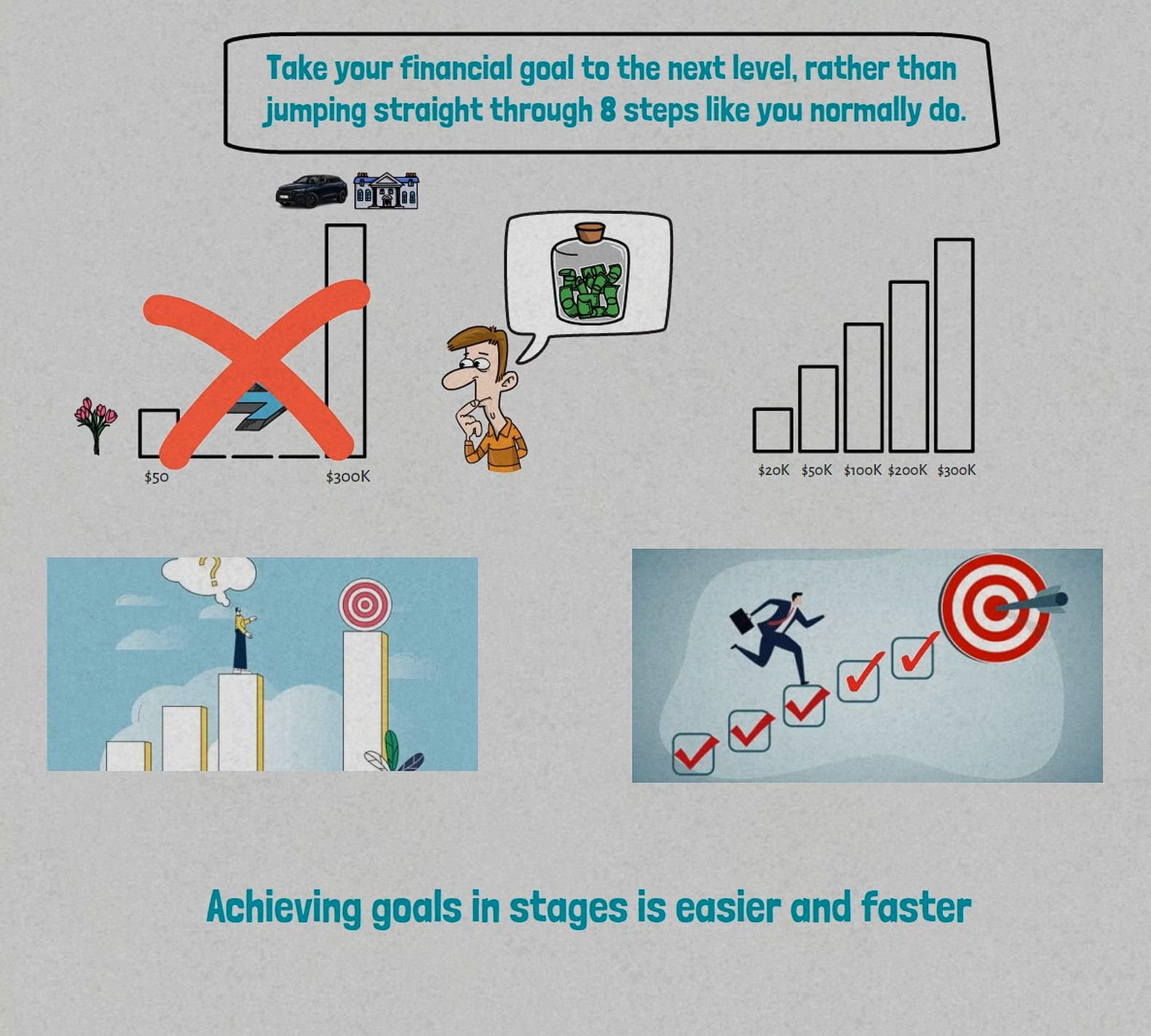
When you move gradually and close a small $20,000 goal first, then the next $50,000 goal, you will ultimately reach the $300,000 faster than if you tried to hit it immediately. You go step-by-step to the next level while fulfilling one major goal at a time. This way, your psyche doesn’t experience discomfort; you aren’t overstraining yourself or “tightening your belt” excessively. And then, in some miraculous way, the money for the next financial goal appears. By the time you’ve adapted to increasingly higher goals and closed the fourth one, the fifth and final goal won’t feel unattainable—it will be just slightly larger than the one you just achieved.